100+ Best MOOC Platforms in 2026: Top Online Course Providers Ranked

A MOOC (Massive Open Online Course) is an online course designed for large-scale participation and open access via the internet. Unlike traditional university courses, MOOCs remove barriers of cost, location, and scheduling. Anyone with an internet connection can enroll, learn, and in many cases earn a certificate recognized by employers worldwide.
The MOOC market was valued at approximately $18.22 billion in 2025 and is projected to reach $60.86 billion by 2030, growing at a CAGR of over 27%. That growth reflects a shift in how professionals, students, and institutions approach education.
This list covers 100+ MOOC providers. The top 30 are reviewed in detail, with full coverage of what they offer, who they suit best, and what it costs. The remaining platforms are listed as a reference for specialized or regional needs.
Last Updated: March 2026
What MOOC Actually Means
The acronym breaks down as follows:
- Massive: Course materials are available to thousands or hundreds of thousands of learners simultaneously, globally.
- Open: Anyone can enroll. Most platforms offer free access to course content, with optional paid certificates.
- Online: Delivery is entirely digital, through video lectures, readings, quizzes, peer assessments, and live sessions.
- Course: Structured learning with a defined syllabus, timeline, and learning outcomes.
How These Platforms Were Evaluated
Every platform in the detailed section was assessed across six criteria: course variety, certificate credibility, cost and free-tier quality, platform usability, employer recognition of credentials, and availability of AI-assisted learning features. Platforms are ordered from most widely used to more specialized.
Quick Comparison: Best MOOC Platforms in 2026
| Platform | Best For | Free Tier | Certificate | Price Range |
|---|---|---|---|---|
| Coursera | University credentials, degrees | View only | Yes (paid) | Free to $79/mo |
| edX | Ivy League content, MicroMasters | View only | Yes (paid) | Free to $300+ |
| Udemy | Skill-based short courses | No | Yes | $10–$200/course |
| Khan Academy | Foundational learning, school-level | Full access | No | Free |
| FutureLearn | Social learning, UK universities | Limited | Yes (paid) | Free to £34.99/mo |
| LinkedIn Learning | Career and business skills | 1-month trial | Yes | $39.99/mo |
| Udacity | Tech nanodegrees | Partial | Yes | $249/mo |
| MIT OpenCourseWare | MIT course materials | Full access | No | Free |
| Skillshare | Creative professionals | No | No | $168/yr |
| Alison | Workplace skills, free certificates | Full access | Yes (paid) | Free |
| NPTEL / Swayam | Indian learners, UGC credit | Full access | Yes (paid) | Free |
| Harvard Open Learning | Harvard-branded programs | View only | Yes (paid) | Free to $200+ |
| Google Career Certificates | Career changers, no-experience roles | View only | Yes (paid) | Via Coursera |
| IBM SkillsBuild / Cognitive Class | AI, data, cloud credentials | Full access | Yes (free badge) | Free |
| Saylor Academy | College-level accredited courses | Full access | Yes | Free |
| Codecademy | Interactive coding education | Limited | Yes (Pro) | $17.49/mo |
| DataCamp | Data science and analytics | Limited | Yes | $25/mo |
| Pluralsight | IT and cloud skills | 10-day trial | Yes | $29/mo |
| NovoEd | Enterprise, cohort-based learning | No | Yes | Enterprise |
| Academic Earth | Curated university lectures | Full access | No | Free |
| The Open University (OpenLearn) | UK-accredited distance learning | Full access | Statement only | Free |
| Complexity Explorer | Complex systems science | Full access | Yes (small fee) | Free |
| Open Yale Courses | Yale undergraduate lectures | Full access | No | Free |
| UoPeople | Accredited degree, low cost | No | Yes | $120–$160/assessment |
| FX Academy | Forex trading education | Full access | Yes | Free |
| Acumen Academy | Social entrepreneurship | Full access | Yes | Free |
| SDG Academy | Sustainable development | Full access | Yes | Free |
| openHPI | Computer science, AI (German/English) | Full access | Yes (free) | Free |
| openSAP | SAP software, enterprise tech | Full access | Yes (free) | Free |
| Grovo | Micro-learning, enterprise training | No | No | Enterprise |
| Carnegie Mellon OLI | Science, engineering foundations | Full access | No | Free |
| P2PU | Peer-to-peer learning circles | Full access | No | Free |
| Canvas Network | Instructor-created open courses | Full access | Yes | Free |
| MongoDB University | Database development | Full access | Yes (free) | Free |
| Edraak | Arabic-language MOOC | Full access | Yes | Free |
| Miríada X | Spanish/Portuguese, Ibero-American | Full access | Yes | Free |
| Open2Study | Short Australian university courses | Full access | Yes | Free |
| OpenLearnCreate | Create and share OER content | Full access | No | Free |
| Janux | University of Oklahoma courses | Full access | No | Free |
| EduKart Open | India-based course aggregator | Full access | Yes | Free |
| ApnaCourse | India-based professional certs | Full access | Yes | Free |
| Universarium | Russian-language courses | Full access | Yes | Free |
| Veduca | Portuguese-language courses (Brazil) | Full access | Yes | Free |
| Iversity | European business and critical thinking | Full access | Yes | Free |
| WizIQ | Virtual classrooms and training | No | Yes | Paid |
| Aquent Gymnasium | Creative and UX skills | Full access | Yes (free) | Free |
| OpenSecurityTraining | Computer security | Full access | No | Free |
| One Month | 30-day self-paced courses | No | Yes | Paid |
| Polimi Open Knowledge | Politecnico di Milano courses | Full access | Yes | Free |
| Leuphana Digital School | Business and digital transformation | Full access | Yes | Free |
| Duke Open Access | Duke University open content | Full access | No | Free |
| GW Online | George Washington University courses | Varies | Yes | Varies |
| IAI Academy | Philosophy and critical thinking | Limited | Yes | Free / Paid |
| OpenCourseWorld | Seminar-style open courses | Full access | Yes | Free |
| The Writing University | Creative writing | Full access | No | Free |
| The Virtual Linguistics Campus | Linguistics and applied linguistics | Full access | Yes | Free |
| UNINETTUNO | Multicultural distance university | Full access | Yes | Free / Paid |
| Commonwealth of Learning | Open learning for Commonwealth nations | Full access | Yes | Free |
| UP2U | Accessible European higher education | Full access | Yes | Free |
| OpenUpEd | Multilingual European higher education | Full access | Yes | Free |
| OpenLearning | Create and run your own MOOC | Full access | Yes | Free / Paid |
| Investoo | Forex trading practice | Full access | No | Free |
| TV des Entrepreneurs | French-language entrepreneurship | Full access | No | Free |
| Neodemia | Spanish-language platform | Full access | Yes | Free |
| Fundación Didáctica | Spanish-language learning | Full access | Yes | Free |
| TareasPlus | Latin American academic support | Full access | No | Free |
| Open English | English language learning | No | Yes | Paid |
| Acamica | Argentina-based, Spanish tech skills | No | Yes | Paid |
| UPV (x) | Universitat Politecnica de Valencia | Full access | Yes | Free |
| SoundviewPro | Business skills via executive summaries | No | No | Paid |
| Sobat.org | Computer accounting | Full access | Yes | Free |
| First Business MOOC | Business fundamentals, EU-focused | Full access | Yes | Free |
| ELD Initiative | Land degradation and environment | Full access | Yes | Free |
| C++ Institute | C and C++ programming | Full access | Yes | Free / Paid |
| Digital Business Academy | UK digital business skills | Full access | Yes | Free |
| George Washington University Open | GWU open educational resources | Full access | No | Free |
| The PLACE | Project-based professional development | Full access | Yes | Free |
| Sathee (IIT Kanpur) | IIT entrance exam prep, India | Full access | No | Free |
| iGOT Karmayogi | Indian civil service learning | Full access | Yes | Free |
The Top 30 MOOC Platforms
1. Coursera
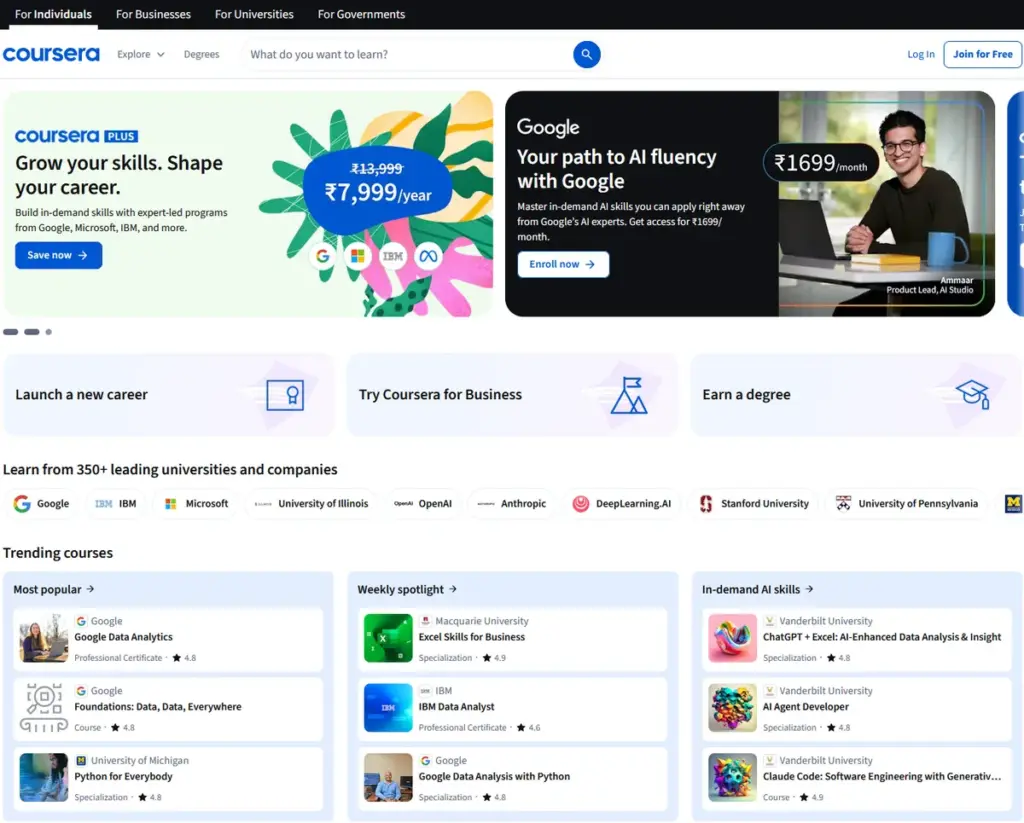
Coursera is the world’s largest MOOC platform by registered learners, with 168.2 million users across 190 countries as of end of 2024. The platform grew its course catalog to over 13,500 courses by end of 2025, a 45% year-over-year increase. It partners with 350+ universities and companies including Google, IBM, Duke University, and Johns Hopkins.
Coursera’s strongest differentiator is its degree-granting capability. Learners can complete accredited bachelor’s and master’s degrees entirely online. In Q4 2024, degree enrollment reached 26,700 students, a 22% year-over-year rise.
Courses can be viewed for free without paying, but earning a certificate requires a paid subscription or one-time purchase. Coursera Plus costs $59 per month or $399 per year and gives unlimited access to most certificates.
- Best for: Career changers, professionals seeking university-level credentials, and learners pursuing online degrees
- Free tier: Yes (view only; assignments and certificates locked)
- Certificate cost: Included in Coursera Plus or per-course purchase ($49 to $299)
- AI features: Coursera Coach, an AI learning assistant embedded in courses, launched in 2024
2. edX
edX was founded by MIT and Harvard and remains one of the most academically rigorous MOOC platforms available. It now operates under 2U Inc. and offers more than 5,000 courses, professional certificates, MicroMasters, and full online degrees from institutions like MIT, Columbia, UC Berkeley, and TU Delft.
The free access track is available for most courses at no cost, allowing learners to view all content without paying. Verified certificates require payment, typically between $50 and $300 per course. MicroMasters programs, which can count toward full master’s degrees, range from $750 to $1,500.
edX’s platform also supports enterprise clients, with features for team management, progress tracking, and custom learning paths.
- Best for: Learners targeting Ivy League content, MicroMasters credentials, or university-pathway programs
- Free tier: Yes (view access available)
- Certificate cost: $50 to $300+ per course; MicroMasters from $750
3. Udemy
Udemy operates a marketplace model, hosting over 250,000 courses created by 70,000+ instructors across 75 languages. Unlike Coursera or edX, courses are not affiliated with universities. They are instructor-created and range from coding and photography to business writing and music production.
Prices per course typically run from $10 to $200, though Udemy runs frequent discounts that can drop courses to $9.99. There is no free tier. Certificates are included with every paid course but carry no formal academic weight. For businesses, Udemy Business provides curated access to top courses for teams.
- Best for: Practical, skill-based learning at low cost; courses never expire after purchase
- Free tier: No
- Certificate cost: Included with course purchase
4. Khan Academy
Khan Academy is the most widely used free educational platform in the world, covering subjects from early mathematics to college-level calculus, economics, and computer science. It is a non-profit, supported by donations, and charges nothing for any content.
The platform excels at foundational learning. It is officially recommended by institutions including UNICEF and the College Board for SAT preparation. There are no certificates. Khan Academy also offers Khanmigo, an AI-powered tutor built on GPT-4, available at no cost for students.
- Best for: Students, school learners, self-paced foundational study at no cost
- Free tier: Full access, entirely free
- Certificate: None
- AI features: Khanmigo AI tutor
5. FutureLearn
FutureLearn is owned by The Open University (UK) and focuses on short-form courses, ExpertTracks, and microcredentials from universities and cultural institutions. Partners include Deakin University, Coventry University, the British Council, and the BBC.
The social learning model is a defining feature, with discussion threads, peer review, and collaborative tasks built into courses. Free access is available for two weeks from a course start date, after which content locks unless you upgrade. FutureLearn also offers degree programs in partnership with accredited UK and Australian universities.
- Best for: UK-based learners, social learners, and those targeting British-accredited credentials
- Free tier: Limited (14-day access window)
- Certificate cost: Included with paid plan or ExpertTrack subscription
6. LinkedIn Learning
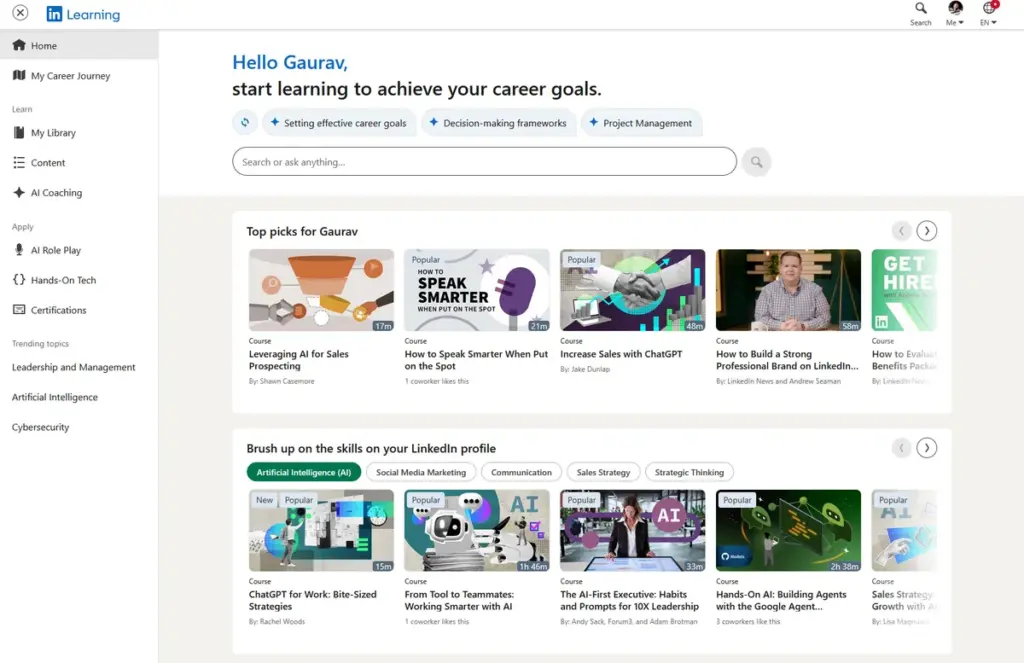
LinkedIn Learning offers over 16,000 courses, and certificates earned are directly added to your LinkedIn profile, making them immediately visible to recruiters. The platform was acquired by LinkedIn in 2015 and integrates with the broader LinkedIn ecosystem for personalized course recommendations based on your job title and career goals.
Course quality is consistent and professionally produced. Topics lean toward business, leadership, technology, and creative skills. Certificates are widely recognized in corporate hiring, particularly for software tools like Excel, Power BI, and project management frameworks.
- Best for: Professionals seeking career-relevant certifications with direct LinkedIn profile integration
- Free tier: One-month trial only
- Certificate cost: Included in subscription ($39.99/month or $239.88/year)
7. Udacity
Udacity is built around “Nanodegree” programs: industry-developed credentials focused exclusively on technology skills, co-created with companies such as Amazon Web Services, Google, Nvidia, and Mercedes-Benz. Curricula reflect current job requirements rather than academic theory.
Each Nanodegree includes real-world projects, code reviews by human mentors, and a career services component. Monthly cost is approximately $249, and most programs run three to four months.
- Best for: Developers, data scientists, and engineers seeking employer-recognized tech credentials
- Free tier: Limited free content and sample lessons
- Certificate cost: $249/month; full programs run $749 to $1,499
8. MIT OpenCourseWare
MIT OpenCourseWare (OCW) publishes virtually all of MIT’s course materials online, completely free, with no registration required. Over 2,500 courses are available, covering engineering, science, management, and humanities. These are the actual syllabi, lecture notes, problem sets, and exams used in MIT classrooms.
OCW does not offer certificates or degrees. It is a pure educational resource. Combining OCW with formal edX programs (which often reference OCW materials) gives learners a clear academic pathway.
- Best for: Self-directed learners who want MIT-level rigor without enrollment requirements
- Free tier: Full access, completely free
- Certificate: None
9. Skillshare
Skillshare is a subscription-based platform with over 35,000 classes, focused primarily on creative and design skills. Topics include illustration, graphic design, video production, photography, UX design, and entrepreneurship. Classes are shorter than typical MOOCs, often 30 to 90 minutes. There are no formal certificates, and the platform is better viewed as a creative practice environment than a credential-issuing institution.
- Best for: Freelancers, designers, and creative professionals developing practical skills
- Free tier: No; trial available
- Certificate: No formal credentials
- Annual cost: ~$168
10. Alison
Alison offers over 4,000 free courses across business, technology, health, and language learning, with certificates available upon completing an assessment. It is one of the only platforms where a recognized certificate can be earned entirely for free. Certificate printing or PDF download costs a small fee ($21 to $34).
Alison targets learners who need basic workplace qualifications and cannot afford paid platforms. Course quality varies, but the breadth of topics makes it a practical first step into formal learning.
- Best for: Budget-conscious learners, career starters, and those needing basic certifications at no cost
- Free tier: Full course access, free
- Certificate cost: $21 to $34 for PDF or printed certificate
11. NPTEL and Swayam (India)
NPTEL (National Programme on Technology Enhanced Learning) and Swayam are Indian government-backed platforms offering free courses with UGC-recognized credit transfer options. NPTEL is run by IITs and IISc. Swayam aggregates content from national institutions. Together, they represent the most credible free online learning infrastructure specifically designed for Indian learners.
Certificates from NPTEL are accepted by many Indian universities for credit transfer. Proctored exams are held at designated centers across India, with registration fees of approximately INR 1,100 per subject.
- Best for: Students in Indian universities, engineering and science learners, those targeting UGC-credited certificates
- Free tier: Full course content free; exams require fee
- Certificate cost: INR 1,100 per proctored exam
12. Harvard Open Learning
Harvard University offers free courses under its Open Learning Initiative, including through HarvardX on edX and directly via online.harvard.edu. Topics span computer science, data science, public health, law, and business. CS50 (Introduction to Computer Science) is among the most enrolled free courses in the world.
Course content is free to view without enrolling in the paid track. Verified certificates require payment. The “Harvard” brand on a certificate carries significant weight in hiring contexts, particularly for CS50 and business-related credentials.
- Best for: Learners seeking Harvard-branded credentials, particularly in computer science and public health
- Free tier: Free to view; certificate requires payment
- Certificate cost: $50 to $200 per course
13. Google Career Certificates
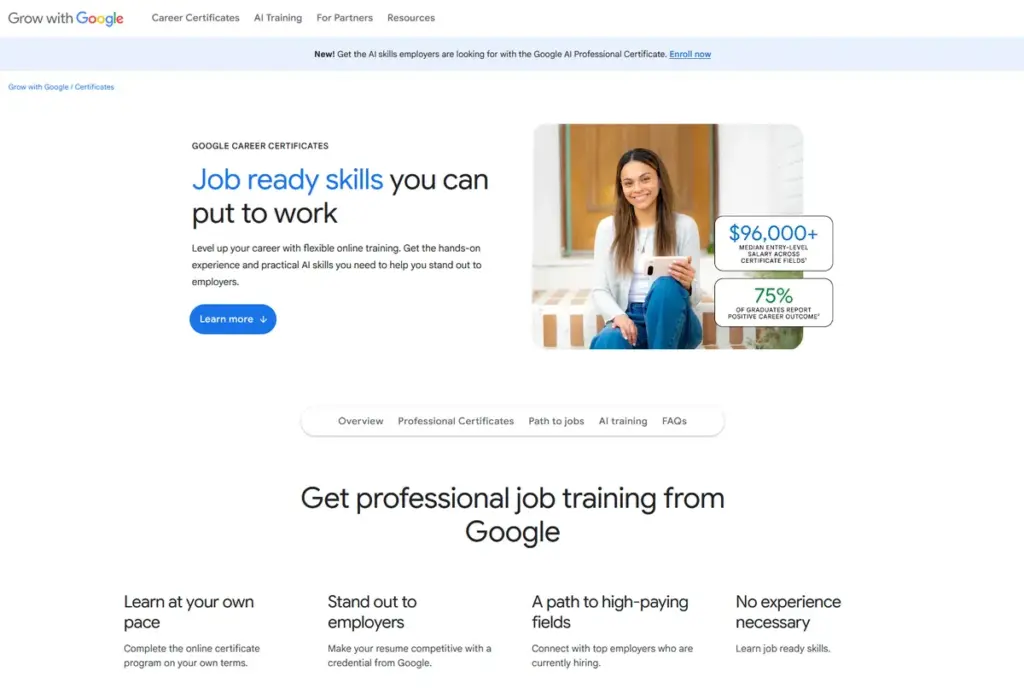
Google offers six career certificate programs through Coursera, covering data analytics, UX design, project management, cybersecurity, IT support, and digital marketing. Each program takes three to six months at ten hours per week. Google has committed to treating these certificates as equivalent to a four-year degree for relevant roles at the company.
Over 200 U.S. employers, including Deloitte, Infosys, and Walmart, have pledged to consider Google certificate holders. This is one of the clearest examples of MOOC credentials with direct employer backing.
- Best for: Career changers with no prior experience in tech, business, or design
- Free tier: View only; Coursera Plus includes all certificates
- Certificate cost: Included in Coursera Plus or $39/month
14. IBM SkillsBuild and Cognitive Class
IBM SkillsBuild and its Cognitive Class platform offer free courses in AI, data science, cloud computing, and cybersecurity, with digital badges issued via Credly. IBM digital badges are blockchain-verified and carry significant industry recognition in tech hiring. Courses are shorter and more targeted than Coursera or edX offerings.
Cognitive Class courses are free and self-paced. IBM SkillsBuild adds career support features including resume building and practice interviews.
- Best for: Tech professionals and career starters targeting IBM-recognized credentials
- Free tier: Full access, free
- Certificate cost: Free (digital badge via Credly)
15. Codecademy
Codecademy specializes in interactive coding education, with a browser-based environment that lets learners write and run code without installing anything. Courses cover Python, JavaScript, HTML/CSS, SQL, Ruby, Go, and more. The free tier includes introductory lessons. A Pro subscription ($17.49/month) unlocks projects, quizzes, and certificates.
Career Paths include full curricula for roles like front-end developer, data scientist, and machine learning engineer.
- Best for: Beginners learning to code; learners who prefer hands-on practice over video lectures
- Free tier: Limited (introductory lessons only)
- Certificate cost: Included in Pro plan
16. DataCamp
DataCamp is built specifically for data science, analytics, and AI learning, offering over 450 courses in Python, R, SQL, Power BI, and machine learning. All exercises run in-browser. The platform includes career tracks that progress from beginner to job-ready.
DataCamp also offers a Workspace tool for building data projects and a Certification program that includes a timed exam and a case study reviewed by a human assessor.
- Best for: Data professionals, analysts, and anyone transitioning into data-related roles
- Free tier: First chapter of most courses free
- Certificate cost: $25/month (annual plan); certifications extra
17. Pluralsight
Pluralsight focuses on technology skills for IT professionals, with a catalog of over 7,000 courses in software development, cloud infrastructure, security, and data. It includes Skill IQ and Role IQ assessments that measure your current level before recommending a learning path, making it one of the few platforms that personalizes learning based on demonstrated ability.
Pluralsight is used extensively by enterprise IT teams for employee development. Individual plans start at $29/month.
- Best for: IT professionals, developers, and teams pursuing cloud and infrastructure skills
- Free tier: 10-day free trial
- Certificate cost: Included in subscription
18. NovoEd
NovoEd is a team-based collaborative learning platform originally founded by a Stanford University professor, designed for enterprise and professional education rather than individual learners. It supports cohort-based courses where participants complete projects in small groups, submit assignments, and receive peer feedback.
The platform is used by companies like Walmart, Unilever, and McKinsey for leadership development. Access is typically through an employer or institution, not individual self-enrollment.
- Best for: Enterprise learning, leadership development, cohort-based professional education
- Pricing: Enterprise contracts; no individual pricing listed publicly
19. Academic Earth
Academic Earth curates free lectures and courses from top universities including Harvard, MIT, Princeton, UC Berkeley, Stanford, and Yale. It does not host its own content. It aggregates and organizes existing open courseware, making it easier to find quality materials without navigating multiple university websites separately. There are no certificates.
- Best for: Self-directed learners who want access to top university lectures for free
- Free tier: Full access, free
- Certificate: None
20. Saylor Academy
Saylor Academy offers fully free, self-paced college-level courses with free certificates upon completion, and partners with select institutions for credit transfer. Over 100 courses are available in business, computer science, history, and science. Saylor is ACE Credit-recommended, meaning transcripts may be accepted by hundreds of U.S. colleges.
- Best for: Learners seeking free college-credit-equivalent courses
- Free tier: Full access, free
- Certificate cost: Free
21. The Open University (OpenLearn)
The Open University (UK) is the largest academic institution in the UK and a world leader in distance education, offering hundreds of free courses through its OpenLearn platform. Free courses do not grant formal credit, but paid programs leading to formal OU qualifications are available. FutureLearn was originally owned by The Open University, reflecting its long commitment to open online education.
- Best for: UK-based learners, adult education, learners preparing for formal Open University qualifications
- Free tier: Full access to OpenLearn courses
- Certificate cost: Free statement of participation; formal credits require paid enrollment
22. Complexity Explorer (Santa Fe Institute)
Complexity Explorer, developed by the Santa Fe Institute in partnership with Portland State University, offers free courses on complex systems science, agent-based modeling, and network theory. It is a niche platform, but the leading open resource in a field that spans economics, ecology, biology, and data science.
- Best for: Researchers, economists, biologists, and professionals working with complex systems
- Free tier: Full access, free
- Certificate cost: Small fee
23. Open Yale Courses
Open Yale Courses provides free access to Yale University’s introductory undergraduate lectures, with high-quality video and full transcripts. Subjects include philosophy, history, physics, and psychology. There are no assessments, interactive components, or certificates. This is a resource for learners who want direct exposure to Yale faculty and thinking without the structure of a formal course.
- Best for: Curious learners and academics who want direct access to Yale’s teaching
- Free tier: Full access, free
- Certificate: None
24. UoPeople (University of the People)
University of the People is the world’s first non-profit, tuition-free, accredited online university, offering bachelor’s and associate’s degrees in business administration, computer science, and health science. Accreditation is from the Distance Education Accrediting Commission (DEAC). Students pay only assessment fees ($120 to $160 per course).
For learners in developing countries or those unable to afford traditional university tuition, UoPeople represents a legitimate degree-granting alternative.
- Best for: Learners in emerging markets, those seeking an accredited degree at minimal cost
- Free tier: No tuition; assessment fees apply
- Certificate cost: $120 to $160 per course assessment
25. FX Academy
FX Academy, operated by DailyForex.com, is a specialized free MOOC focused entirely on Forex trading education. It covers technical analysis, fundamental analysis, risk management, and trading psychology. All content is free and self-paced. For learners focused on financial markets, this platform offers depth not found on general MOOC sites.
- Best for: Aspiring Forex traders and finance learners focused on currency markets
- Free tier: Full access, free
- Certificate: Available upon course completion
26. Acumen Academy
Acumen Academy offers free online courses for social entrepreneurs and change leaders. Topics include social innovation, leadership, and human-centered design. Certificates are available and respected in the non-profit and international development sectors.
Courses are short, typically two to five weeks, and are taught by practitioners with direct field experience. The platform is run by Acumen, a non-profit global venture fund with a strong reputation in social impact.
- Best for: Social entrepreneurs, non-profit professionals, development sector workers
- Free tier: Full access, free
- Certificate: Yes, free
27. SDG Academy
SDG Academy provides courses on sustainable development created by leading global experts, tied directly to the United Nations’ Sustainable Development Goals. The platform operates through the Sustainable Development Solutions Network (SDSN) and delivers content via edX.
Topics span climate science, urban development, food systems, poverty reduction, and public health. Courses are academically rigorous and suitable for graduate-level learners and policy professionals.
- Best for: Professionals in public policy, international development, environmental science, and academic researchers
- Free tier: Free to view (via edX free access)
- Certificate: Yes (paid, via edX)
28. openHPI
openHPI, run by the Hasso Plattner Institute (HPI) in Germany, offers free courses in computer science, AI, and digital transformation in both German and English. HPI is one of Europe’s top computer science institutions, and openHPI reflects that academic quality in each course.
Certificates are free. Courses run as instructor-led cohorts with a fixed schedule, then remain available for self-paced completion. The platform has issued over 800,000 certificates to learners in more than 180 countries.
- Best for: Computer science students, SAP-ecosystem professionals, European learners seeking free technical credentials
- Free tier: Full access, free
- Certificate cost: Free
29. openSAP
openSAP is SAP’s enterprise MOOC platform, providing free courses on SAP software, AI in business, and digital transformation. Courses are designed for professionals working within or transitioning into SAP ecosystems. The platform has received multiple learning industry awards.
openSAP courses typically run four to six weeks and are taught by SAP employees and certified partners. Certificates are free upon passing the final assessment. The catalog includes courses on S/4HANA, SAP BTP, SAP AI, and sustainability in enterprise operations.
- Best for: SAP consultants, enterprise software professionals, IT teams in SAP-dependent organizations
- Free tier: Full access, free
- Certificate cost: Free
30. Grovo
Grovo is a micro-learning platform offering over 4,800 short video lessons covering 160+ subjects, focused on internet tools, cloud platforms, and professional software. It is primarily used by businesses for employee training rather than by individual learners.
Lessons run approximately 90 seconds each, designed for delivery during onboarding and team upskilling sessions. Grovo is now part of the Cornerstone OnDemand ecosystem and is sold as part of enterprise learning management solutions.
- Best for: HR teams, enterprise L&D departments, software onboarding at scale
- Free tier: No
- Certificate: No formal certificates
- Pricing: Enterprise; via Cornerstone OnDemand
University-Affiliated, Specialist, and Regional Platforms
University-Affiliated Platforms
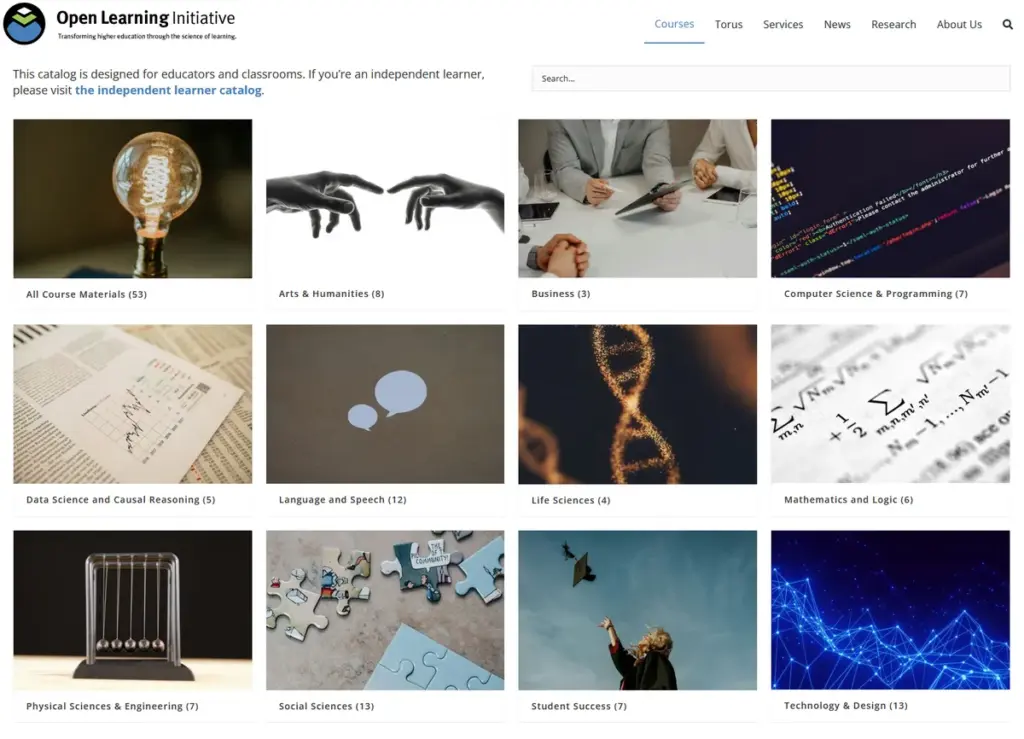
Carnegie Mellon Open Learning Initiative (OLI) provides free, research-backed courses in statistics, biology, chemistry, and calculus. Developed at Carnegie Mellon University, each course is built on learning science principles with adaptive feedback. No certificates, but the content quality is exceptional for foundational STEM learning.
P2PU (Peer 2 Peer University) runs learning circles: in-person or online study groups facilitated by community members using free online course content. P2PU does not create courses; it provides a framework for social learning around existing MOOCs. Particularly active in public libraries across the US and Africa.
Canvas Network is an open MOOC platform built on the Canvas LMS by Instructure. Instructors at any institution can publish courses here. Access is free and certificates are available. Course quality varies depending on the instructor institution.
Polimi Open Knowledge (POK) offers free courses from Politecnico di Milano, one of Europe’s top engineering and design universities. Courses are available in Italian and English, covering engineering, design, management, and urban studies.
Leuphana Digital School offers business and digital transformation courses from Leuphana University in Germany. Content is available in English and targets professionals and managers navigating digital change. Certificates are free upon completion.
Duke University Open Access makes Duke’s open educational resources available without enrollment. Content is not structured as formal MOOCs but as downloadable materials. Duke’s formal online courses are delivered through Coursera.
GW Online (George Washington University) offers formal paid online programs as well as select open content. GWU’s open courseware is less structured than MIT OCW but relevant for political science, international affairs, and public health disciplines.
IAI Academy (Institute of Art and Ideas) offers philosophy-focused courses built around IAI’s video lecture archive. Courses are short and debate-driven, with a unique editorial perspective. Some content is free; full access requires a subscription.
Janux is the University of Oklahoma’s open learning platform. Courses are available for free in areas including meteorology, Native American studies, and business. Janux has a smaller catalog but covers topics not widely found on major platforms.
Open2Study is operated by Open Universities Australia and offers short courses from Australian universities. Topics span business, IT, design, and education. Completion certificates are available and recognized within the Australian education system.
UNINETTUNO is an internationally accredited online university based in Rome, offering degree programs and open courses in multiple languages including Arabic, Italian, English, French, and Greek. Particularly relevant for Mediterranean and Middle Eastern learners seeking European accreditation.
Commonwealth of Learning is an intergovernmental organization that creates and shares open educational resources for Commonwealth member nations. It supports educators and institutions rather than individual learners directly, but its OER content is freely accessible.
UP2U is a European H2020-funded project providing an integrated platform for higher education with an emphasis on accessibility and open learning environments. Partners include universities across Italy, Germany, Belgium, and Switzerland.
OpenUpEd is the first pan-European MOOC initiative, backed by the European Association of Distance Teaching Universities. It supports courses in multiple European languages and emphasizes quality assurance through institutional partnerships.
Specialist Platforms
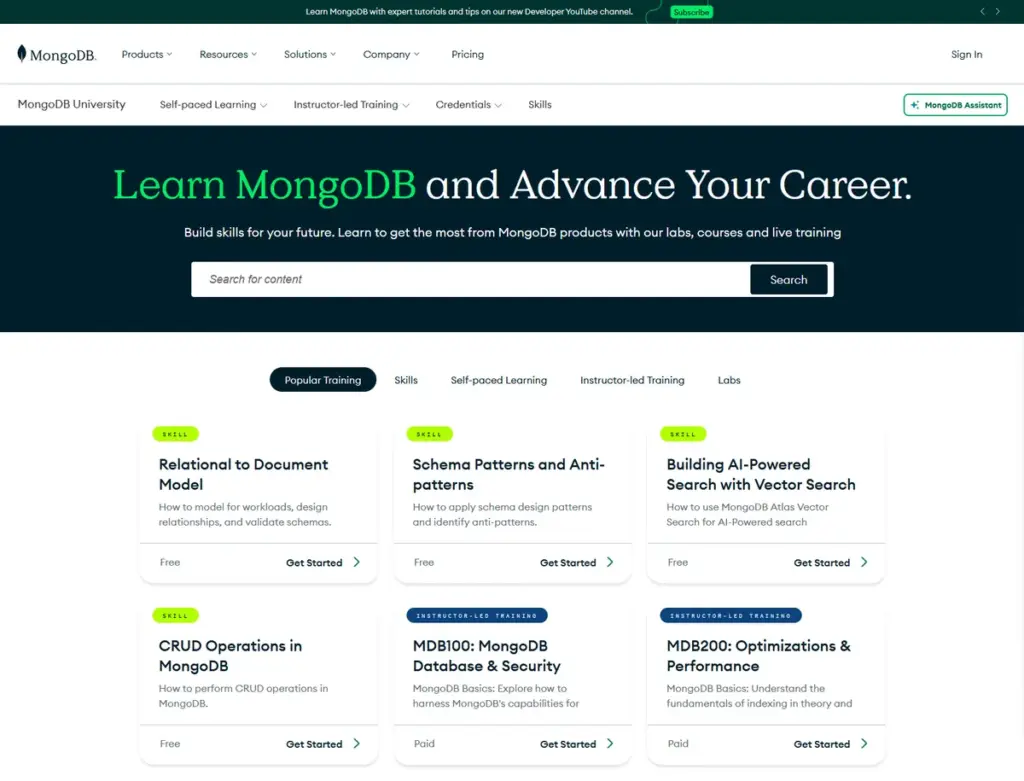
MongoDB University offers free courses and learning paths for developers working with MongoDB, a widely used NoSQL database. Certifications are available through paid exams and carry strong recognition in backend and data engineering hiring.
OpenSecurityTraining provides free, in-depth computer security courses covering reverse engineering, malware analysis, exploit development, and network security. Content is advanced and suited for security researchers and professionals. No certificates.
Aquent Gymnasium offers free courses in UX design, web development, accessibility, and digital marketing, developed in collaboration with industry practitioners. Certificates are free upon completion. Particularly strong for designers transitioning into UX or front-end development roles.
C++ Institute provides structured C and C++ programming education with free study materials and certification exams. Certifications are vendor-neutral and recognized in embedded systems and system programming hiring contexts.
One Month offers 30-day self-paced courses in Python, HTML, JavaScript, and growth marketing, built around the idea that foundational skills can be acquired in a single focused month. No free tier; individual courses are priced between $49 and $199.
OpenCourseWorld is a German-based open course platform supporting seminar-style learning for academic and professional audiences. Courses are created by universities, foundations, and public organizations. Content is available in German and English.
The Writing University is run by the University of Iowa’s International Writing Program and offers free access to craft essays, lectures, and resources on creative writing. No formal courses or certificates, but a deep resource for serious writers.
The Virtual Linguistics Campus is run by Philipps University of Marburg and offers free linguistics courses covering phonetics, syntax, semantics, and applied linguistics. Certificates are available. Useful for linguistics students and language teachers.
ELD Initiative (Economics of Land Degradation) offers free courses on land use, environmental economics, and sustainable agriculture. Relevant for professionals in environmental policy, agriculture, and development finance.
First Business MOOC is an EU-funded platform offering business fundamentals courses for early-stage entrepreneurs and small business owners across European member states. Content is free and available in multiple European languages.
SoundviewPro provides access to executive book summaries and video learning on business strategy, leadership, and management. Content is short-form and designed for busy professionals. Requires a paid subscription.
Sobat.org offers free self-paced courses in computerized accounting, focusing on tools used in Southeast Asian financial markets. Relevant for accounting professionals in Indonesia and surrounding regions.
WizIQ is a virtual classroom and online tutoring platform used by educators to deliver live instruction. It supports synchronous learning with whiteboards, breakout rooms, and assessments. Primarily a teaching tool rather than a learner-facing MOOC platform.
OpenLearning is an Australian platform that allows institutions and educators to create and publish MOOCs. Learners can enroll in hosted courses; institutions use it to run accredited programs. Particularly active in the Asia-Pacific region.
PLACE (The PLACE) is an EU-funded initiative providing project-based professional development for educators and public sector professionals. Courses are co-created with European universities and available in multiple languages.
iGOT Karmayogi is India’s government-run learning platform for civil servants and public employees. Courses are free and cover governance, public policy, digital skills, and ethics. Certificates carry formal recognition within the Indian civil service.
Sathee (IIT Kanpur) is a free platform developed by IIT Kanpur to help students prepare for JEE, NEET, and UPSC examinations. Content is available in English and Hindi and includes full-length video lectures, practice tests, and study materials.
Digital Business Academy is a UK-based initiative providing free digital business skills training to entrepreneurs and professionals. Supported by Tech City UK, it covers areas including digital marketing, coding, product development, and scaling startups.
Platforms for Emerging Markets and Non-English Learners
Edraak is the leading Arabic-language MOOC platform, operated by the Queen Rania Foundation in Jordan. It serves learners across the Arab world with courses in technology, business, language, and professional development. Certificates are available and the platform has issued millions of certificates since its founding in 2014.
Miríada X is the largest Spanish and Portuguese MOOC platform in the world, operated by Telefónica Educación Digital and serving universities across the Ibero-American region. It hosts courses from 100+ universities including Universidad Complutense de Madrid, Universidad de Chile, and UNAM. Certificates are free upon completion.
Veduca is a Brazilian platform offering Portuguese-language courses from leading universities including USP (University of São Paulo). Topics include business, technology, and social sciences. Certificates are available for paid courses.
Universarium is Russia’s national MOOC platform, developed with support from leading Russian universities. Courses are in Russian and cover a wide range of academic and professional disciplines. Certificates are recognized by participating Russian institutions.
Universiteplus (now operating as Unow in France) provides professional training MOOCs in French, with a focus on business and personal development. Courses are cohort-based with coaching support. Widely used for professional development within French-speaking regions.
UPV (x) is the MOOC platform of Universitat Politecnica de Valencia, offering free Spanish-language engineering, technology, and design courses. Certificates are available and recognized within the Spanish higher education system.
TV des Entrepreneurs is a French-language video learning platform for entrepreneurs, covering business creation, marketing, finance, and management. Content is free and video-driven. No formal certificates.
Neodemia is a Spanish-language MOOC platform offering courses across technology, business, and personal development. Certificates are available. Designed for Latin American learners across multiple countries.
Fundación Didáctica provides free Spanish-language educational content for learners in Spain and Latin America. Courses are accessible to all skill levels and cover academic, vocational, and personal development topics.
TareasPlus is a Latin American academic support platform offering tutorial videos and explanations for school and university subjects in Spanish. It functions more as supplementary academic support than a structured MOOC. No certificates.
Open English is a paid English-language learning platform targeting Spanish-speaking learners across Latin America. Classes are live and instructor-led. Certificates are available. It is one of the largest online English learning platforms in the region.
Acamica is an Argentina-based platform offering tech skills bootcamps and career programs in Spanish, with strong job placement support for Latin American learners. Courses focus on web development, data science, and UX design.
EduKart Open is an India-based platform aggregating professional certification courses in areas including digital marketing, finance, and HR. Certificates are issued in partnership with training bodies and professional institutes.
ApnaCourse is an India-based platform offering free and low-cost courses in computer skills, spoken English, and professional development, targeted at learners in tier-2 and tier-3 Indian cities.
Free vs. Paid MOOC Platforms: Which Should You Choose?
The choice depends on what you need the credential for.
| Factor | Free Platform | Paid Platform |
|---|---|---|
| Certificate value | Low to moderate | Moderate to high |
| Course depth | Varies widely | Generally consistent |
| Employer recognition | Limited | Stronger (Google, IBM, Coursera) |
| Flexibility | High | High |
| Best use case | Skill building, exploration | Career transition, credential earning |
| Examples | Khan Academy, MIT OCW, NPTEL | Coursera, LinkedIn Learning, Udacity |
If your goal is career advancement or credential documentation, a paid certificate from a recognized platform will carry more weight than a free one. If your goal is learning for personal development, free platforms offer excellent content with no trade-off.
Best MOOC Platforms by Goal
Best for AI and Data Science
Coursera (IBM and Google certificates), DataCamp, edX (MIT programs), Udacity (AI Nanodegrees), Pluralsight
Best for Coding and Software Development
Codecademy, Udemy, Udacity, Pluralsight, openHPI, MongoDB University
Best for Business and Leadership
LinkedIn Learning, Coursera (Wharton, Yale SOM courses), FutureLearn, NovoEd, Alison
Best for Indian Learners
NPTEL and Swayam (UGC credit recognition, INR pricing), Coursera (financial aid available), edX (free to view), Alison, Sathee (exam prep)
Best for Free University-Level Content
MIT OpenCourseWare, Open Yale Courses, Harvard Open Learning, Academic Earth, Saylor Academy
Are MOOC Certificates Worth It? What Employers Actually Say
Employer recognition of MOOC certificates has grown considerably since 2020, particularly for certificates issued by Google, IBM, and top universities via Coursera or edX. According to Coursera’s 2025 Learner Outcomes Report, 86% of learners pursue courses for career-related reasons, and a significant portion report tangible outcomes including promotions, new jobs, or salary increases.
Certificates are strongest when they come from a known brand (Google, IBM, Microsoft), a named university, or are tied to a specific skill assessment, as with Udacity’s Nanodegrees or DataCamp’s certifications. Generic course completion certificates from lesser-known platforms carry less weight in applications.
Treat certificates as supporting evidence, not primary qualifications. When combined with a portfolio of projects, they become considerably more credible.
How to Choose the Right MOOC Platform
- Define your goal first. Are you switching careers, upskilling in your current role, earning academic credit, or learning for personal interest? Each goal maps to a different type of platform.
- Check the certificate’s credibility. Research whether employers in your target field recognize the issuing institution or platform.
- Assess the free tier honestly. Many platforms offer free access that includes all video content but no certificate or graded assignments. Decide whether you need the formal credential.
- Consider your learning style. Platforms like NovoEd and FutureLearn suit collaborative learners. Khan Academy and MIT OCW suit self-directed, independent learners.
- Match your budget. If cost is a constraint, NPTEL (for India), Alison, Saylor, and MIT OCW provide genuine value at no cost.
Frequently Asked Questions
What is the best MOOC platform for beginners?
Khan Academy for foundational subjects, Codecademy for coding, and Coursera or edX for structured university-style learning. All three offer free access to get started.
Can I get a job with a MOOC certificate?
Yes, particularly for Google Career Certificates, IBM credentials, and Coursera or edX certificates from named institutions. The certificate works best when paired with a project portfolio.
What is the difference between Coursera and edX?
Both offer university-level courses with free view access and paid certificates. Coursera has a larger learner base (168 million+) and stronger degree programs. edX has more MIT-specific content and MicroMasters programs that can transfer to formal master’s degrees.
Are there free MOOCs with certificates in 2026?
Yes. Alison, Saylor Academy, NPTEL, IBM Cognitive Class, and Google Digital Garage all offer free certificates with no subscription required.
Which MOOC platform is best in India?
NPTEL and Swayam for UGC-recognized credentials. Coursera with financial aid for international certificates. Alison for free workplace skill certificates. Sathee for competitive exam preparation.
How long does a MOOC course take to complete?
Short courses run two to four weeks at three to five hours per week. Full professional certificates take three to six months. Nanodegree programs and MicroMasters typically take four to twelve months.
Recommended Reading
15 Best MOOC Aggregators for Free Online Courses
Learning Resources